There's a decent chance you've already built API orchestration and just never called it that.
That gnarly function in your backend that calls three services, waits, checks a condition, and stitches the results into one response?
That's it. That's the whole thing.
It usually shows up as duct tape first and gets a name later, right around the time someone asks why one endpoint takes 400 milliseconds and three engineers to debug it.
This guide gives it an actual name, the mechanics behind it, the neighboring terms everyone mixes up, and the point where duct tape stops being enough.
1. What API Orchestration Actually Means
API orchestration is the coordination layer that sequences calls to multiple APIs, applies logic between them, and returns a single response to the caller.
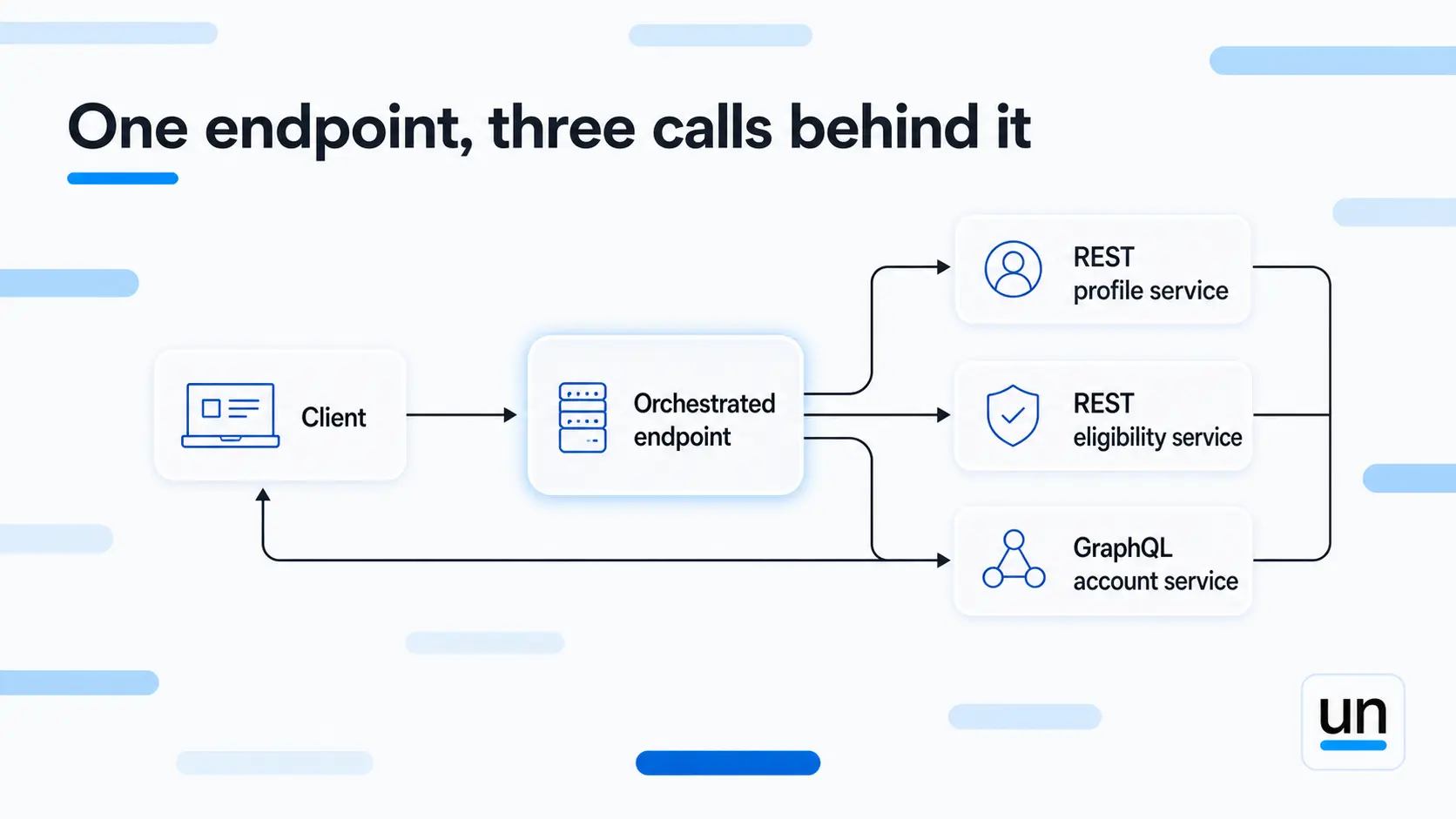
Take a customer response endpoint as an example. Instead of the client calling three services directly, it calls one orchestrated endpoint. That endpoint fans out to a REST profile service, a REST eligibility service, and a GraphQL account service in parallel, merges the results, and returns one payload.
The client never has to know there were three calls behind it.
That's the core of the idea. Orchestration owns the sequence, the logic, and the error handling, so nothing else in the system has to.
2. How API Orchestration Works
Strip away the marketing, and it comes down to six steps:
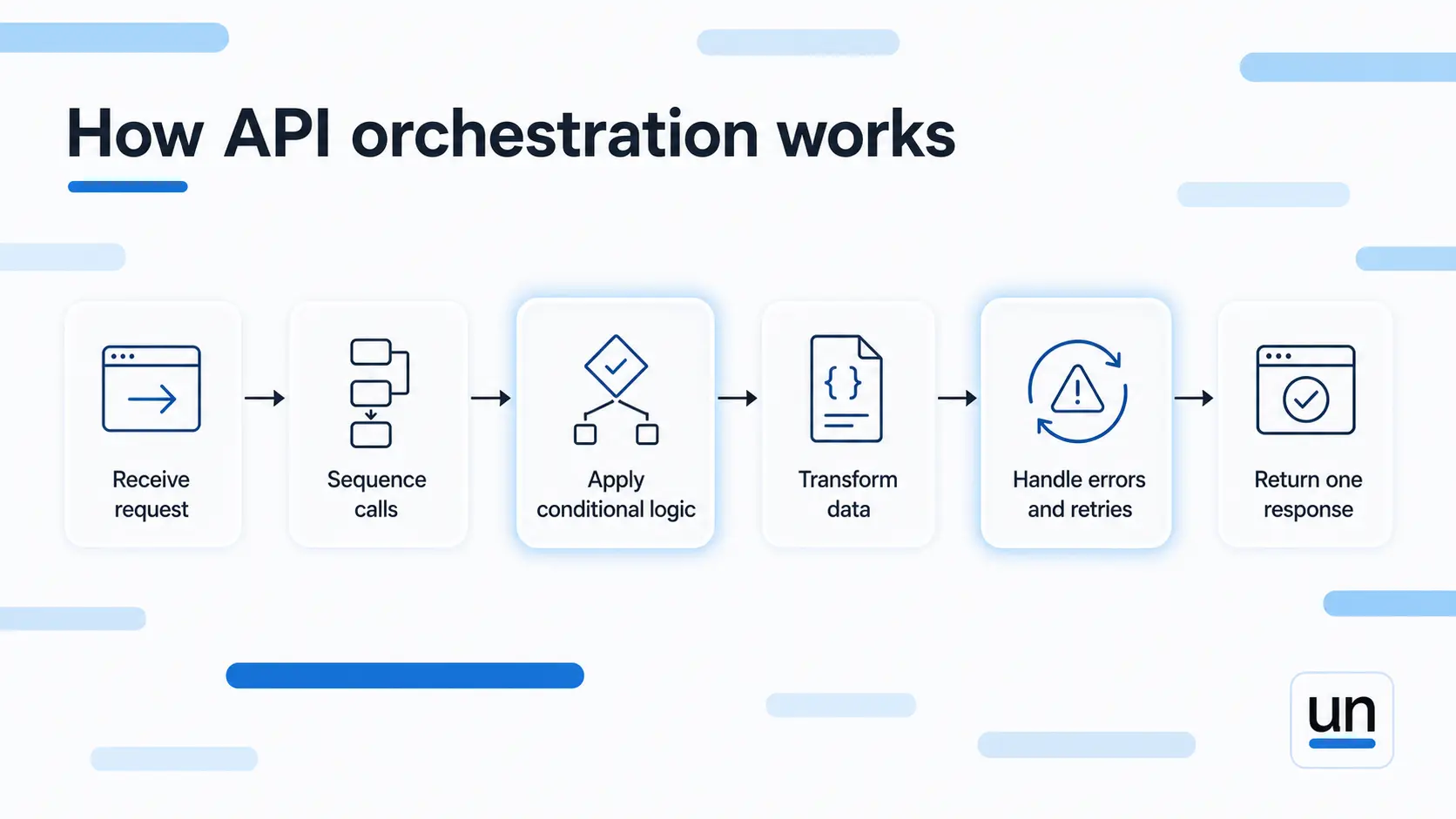
- Receive the request
- Sequence or parallelize the calls
- Apply conditional logic based on what comes back
- Transform the data into the shape the caller needs
- Handle errors and retries centrally
- Return one response
Steps three and five are where orchestration actually earns its keep.
A basic aggregation layer can merge data from two calls. It generally can't decide what to do when call two fails but calls one and three succeeded, or route around a service that's returning errors.
That decision-making is what separates real orchestration from simpler data-merging patterns.
3. API Orchestration vs. API Composition vs. Choreography
These three terms get used interchangeably, and that mix-up has caused more confused architecture diagrams than almost any other API concept. They are not the same thing.
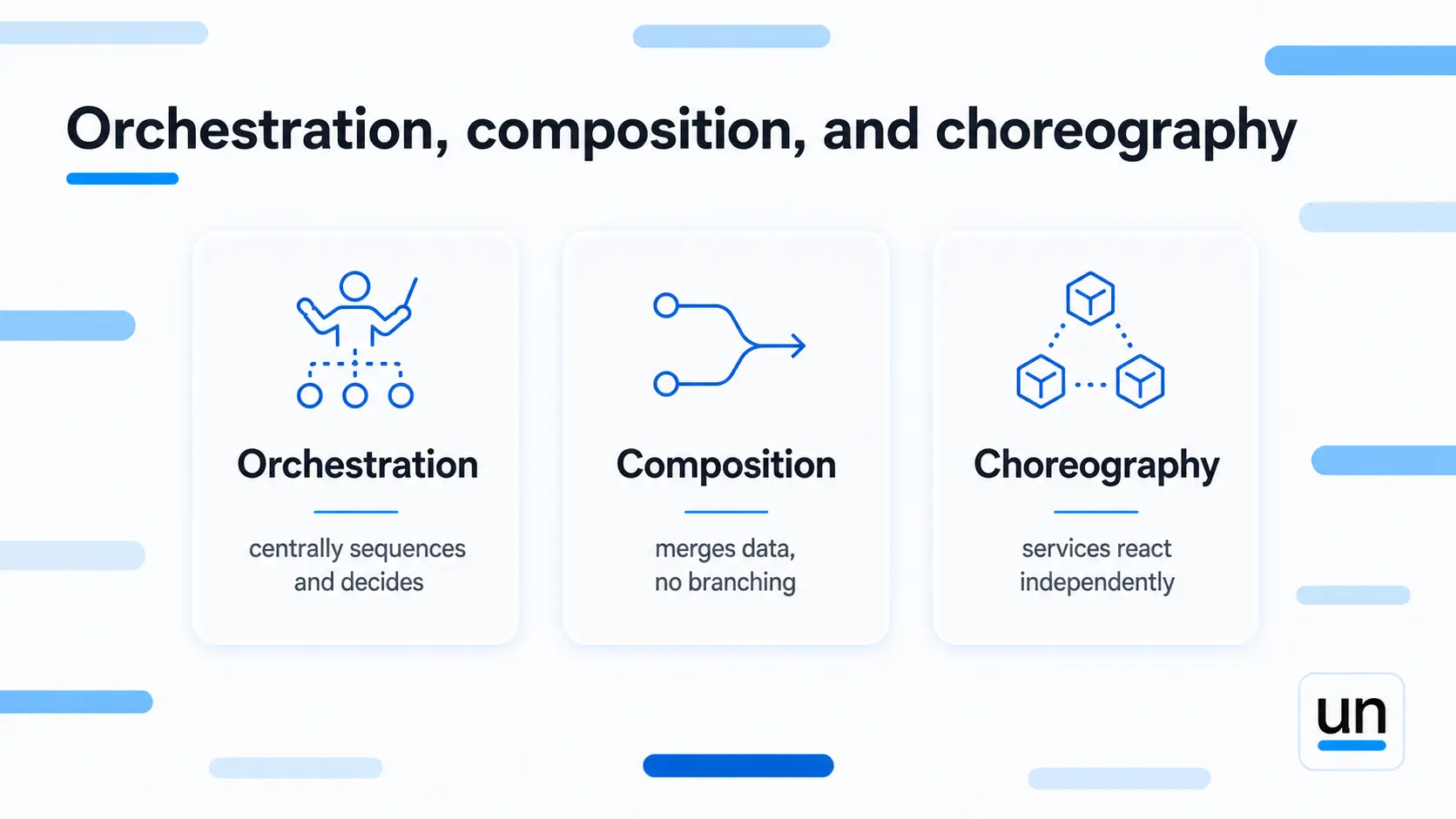
Comparison: orchestration, composition, and choreography
| Approach | What it does | Best for |
|---|---|---|
| API orchestration | Centrally sequences calls, applies logic and error handling, and returns one result | Multi-step processes with real dependencies between calls |
| API composition | Merges data from several APIs into one response | Read-only aggregation with no branching logic |
| Choreography | Services react to events independently, with no central coordinator | Loosely coupled, event-driven systems |
The short version: composition merges, API orchestration decides, and choreography just reacts. If you want the deeper breakdown on the event-driven side of this, we've written a separate piece on choreography.
4. Common API Orchestration Patterns
Most of this work falls into one of four patterns. Recognizing which one you're building makes every design decision after it easier.
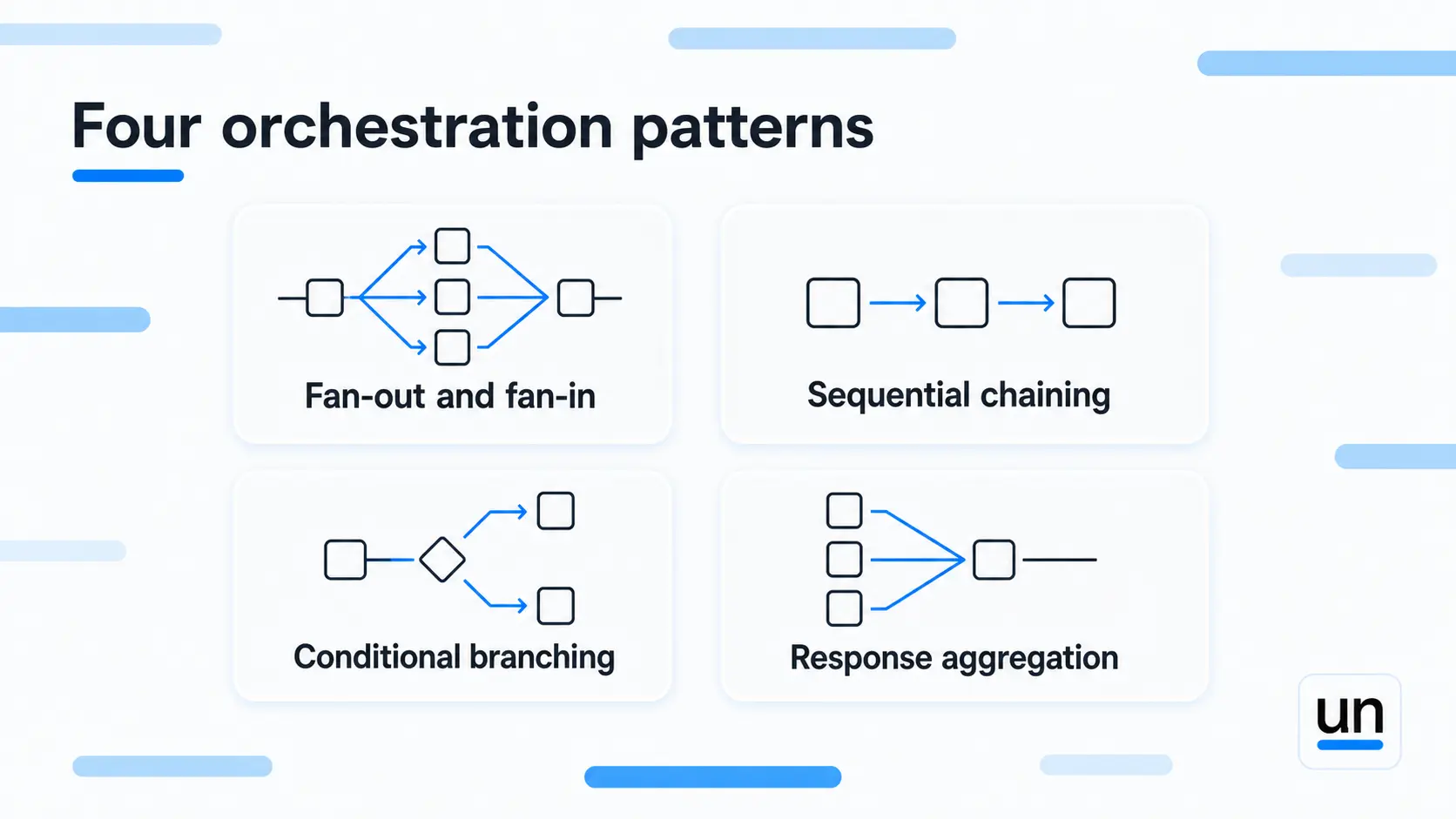
Fan-out and fan-in
Call several services in parallel, then merge the results into one response. This is one of the most common REST API orchestration patterns, and the one behind most "single endpoint, many systems" designs.
Sequential chaining
Each call depends on the result of the one before it, so they have to run in order. We cover this pattern in more depth in sequential calls.
Conditional branching
The next call, or whether there's a next call at all, depends on what a prior step returned.
Response aggregation
Multiple results get assembled into a single contract for the client, often with a transformation step in between. For a closer look at chaining specifically, see REST chaining.
5. When You Need an Orchestration Layer (and When You Don't)
Before you start comparing API orchestration tools, it's worth asking whether you need a dedicated orchestration layer at all. Not every API problem does. Here's how to tell.
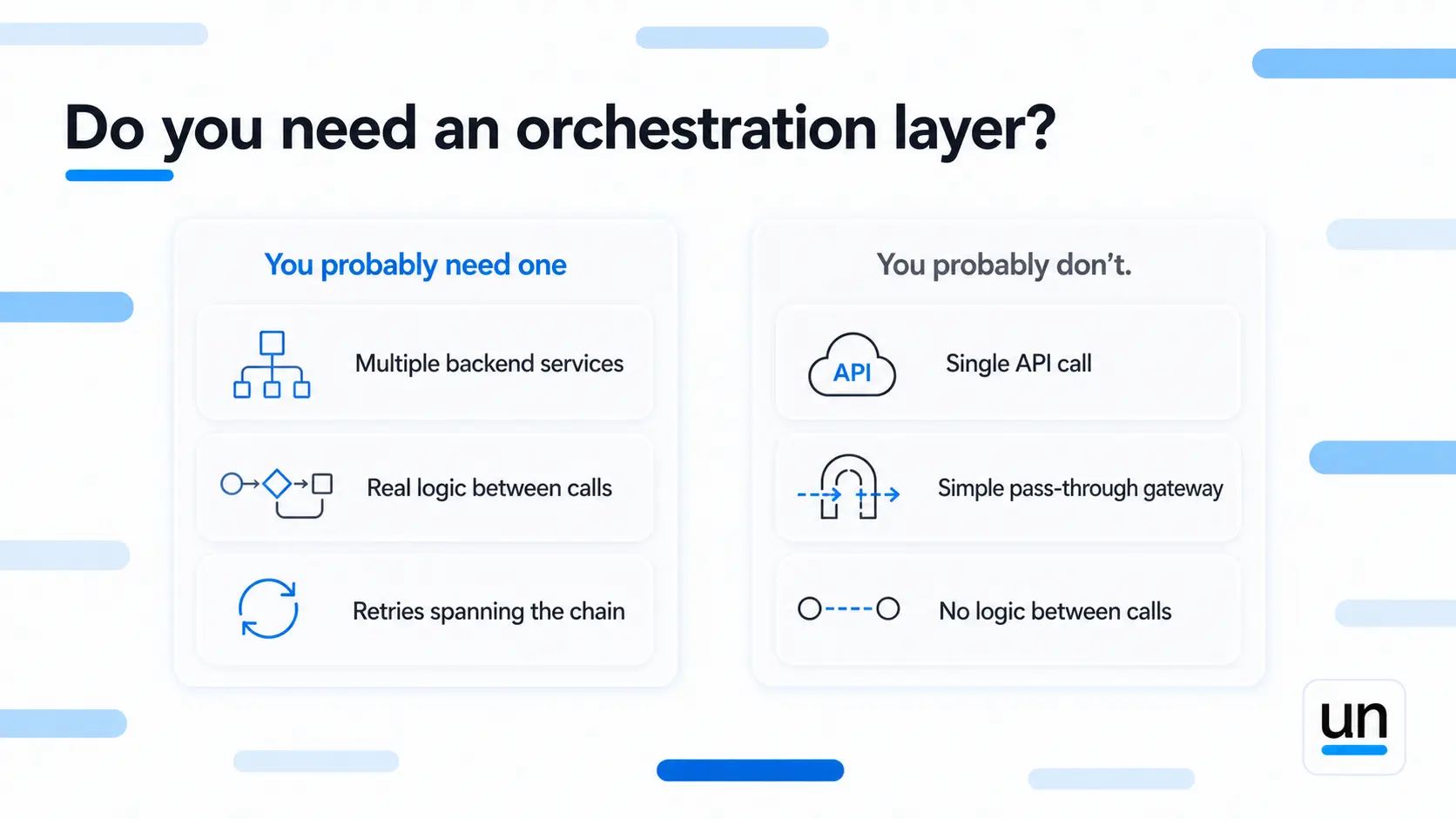
You probably need one if:
- A single request needs data from more than one backend service
- There's real business logic between calls, not just a straight pass-through
- Retries and error handling need to span the whole chain, not just one call
- You need visibility into the full call path when something breaks, not just individual service logs
You probably don't if:
- You're making a single API call
- A simple pass-through gateway already covers what you need
- There's no logic between calls, just a proxy
Getting this wrong in either direction costs you.
Build a dedicated layer for a single pass-through call, and you've added infrastructure for nothing. Skip it for a genuinely multi-step process, and you end up rebuilding retry logic and error handling in every client that calls it.
See it built in Unmeshed
If that sounds like your API, try the fan-out and merge pattern yourself.
6. How Unmeshed Handles API Orchestration
Unmeshed fans out to REST and GraphQL sources in parallel, then assembles the response with JavaScript steps that run inline. No separate service to deploy or maintain. Step-to-step overhead stays close to nil, since most of the latency in this pattern comes from the upstream APIs, not the orchestration layer.
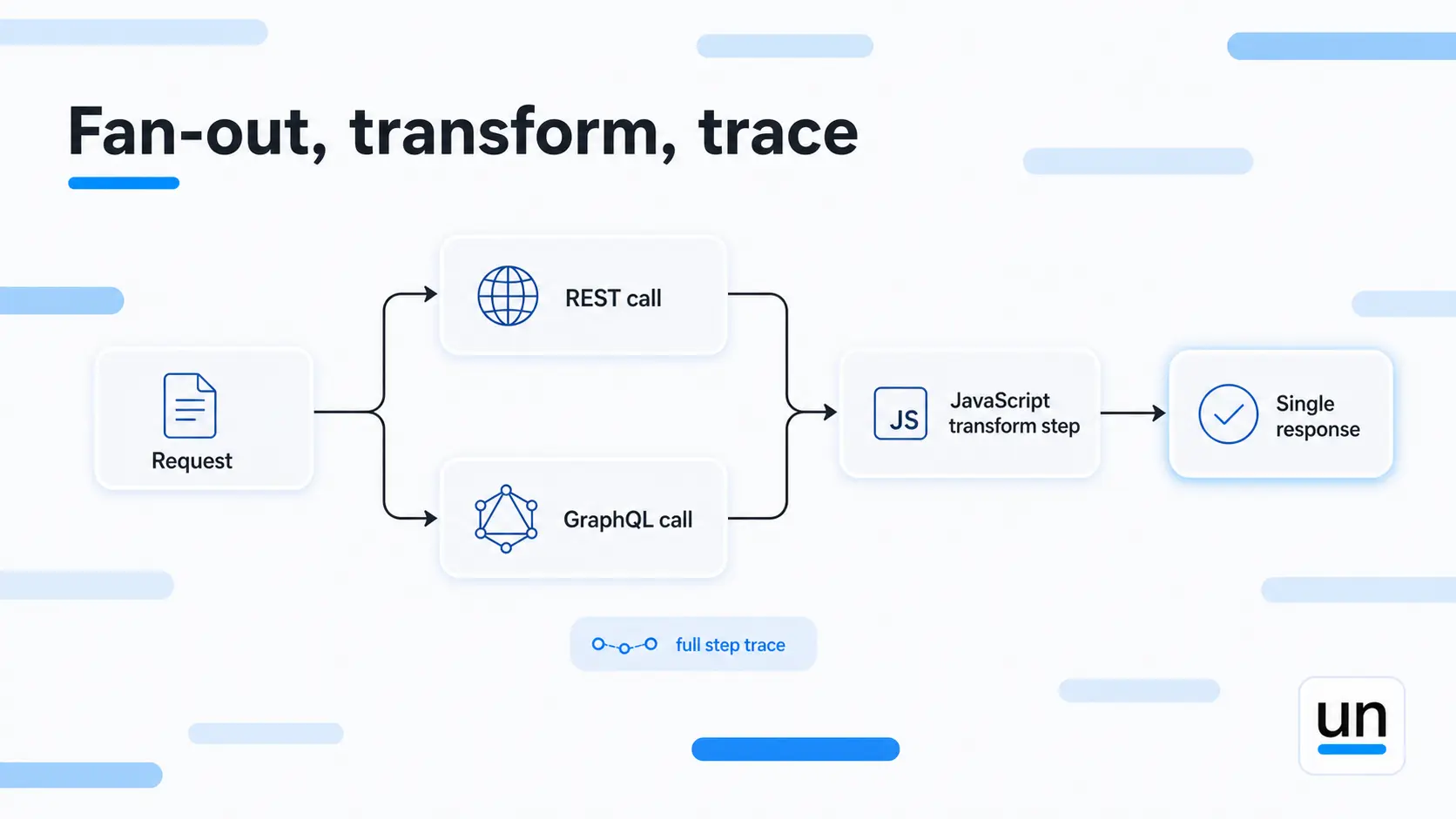
What Happens Under the Hood
- Every step passes data forward using contextual references (
{{ steps.X.output.Y }}), so a REST call can feed a GraphQL call can feed a transformation step without gluing outputs together by hand - Retries, timeouts, and error routing are centralized and configurable per step, so one flaky downstream service degrades gracefully instead of taking the whole response down
- Every execution is captured as a full, step-by-step trace. See exactly which call ran, what it returned, and replay it on demand
- Rate limiting, input and output validation, and dynamic call routing are built in
What Changes Once It's Live
- Authentication and secrets (API keys, Okta, custom headers) live inside the platform, not scattered across config files
- Streaming responses are supported natively, for cases where partial results matter more than waiting on the full chain
- Workflow definitions export as JSON, so orchestration logic gets versioned and deployed through the same CI/CD pipeline as everything else
Build It Yourself vs. Get It Built In
Two ways to get here. Most teams start with the first one.
Build it yourself:
- A gateway that owns the fan-out logic
- Retry and timeout handling written and maintained per endpoint
- Tracing and replay built from scratch
- Secrets management wired up again for every new integration
With Unmeshed:
- All of the above, centralized once
- A new integration is a new step in an existing flow, not a new system to build
Teams build the first version, and some do it well. But it's infrastructure work that has nothing to do with the actual product, and most of it gets rebuilt every time you add a downstream service.
For a closer look at why purpose-built orchestration outperforms traditional platforms built for slower, state-heavy workloads, we've covered that separately. And to see this running under real production load, commodity trading shows it end to end.
Worth a read: For orchestration patterns applied to a real, high-throughput use case, see commodity trading. For the broader efficiency case, see drives efficiency.
Frequently Asked Questions
Building an orchestration layer from scratch?
See how Unmeshed handles it out of the box
Try Unmeshed free, or talk to us about your specific API orchestration use case.